
- Your cart is empty
- Continue Shopping
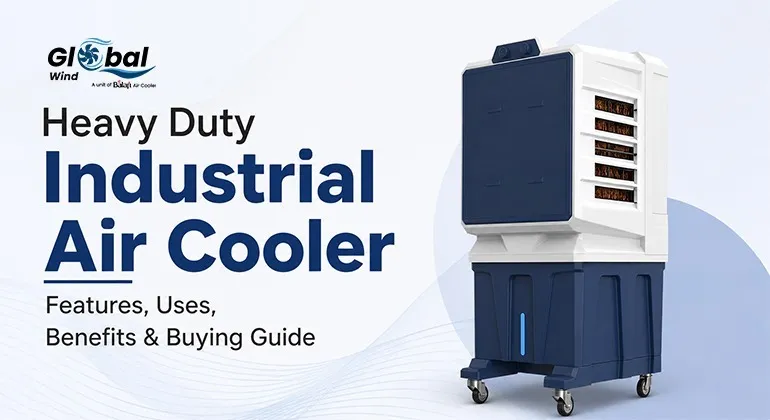
Heavy Duty Industrial Air Cooler: Features, Uses, Benefits & Buying Guide
Higher temperatures can affect day-to-day operations and employee comfort in factories and commercial facilities. A heavy-duty industrial air cooler is an effective way to cool, increase airflow, increase productivity, and help keep workers comfortable; all the while, it is more energy-efficient than other cooling methods.
What Is a Heavy-Duty Industrial Air Cooler and How Does It Work?
A heavy-duty industrial air cooler is basically an evaporative cooling setup meant to chill big industrial and commercial rooms. It works by pulling warm air through water-soaked cooling pads, and the heat gets taken up as the water evaporates, like a slow transformation, without the need for refrigerants. So you get chilled airflow, not from compressors or stuff like that, but from the evaporation itself.
A water pump keeps sending water to the cooling pads, while a high-capacity fan spreads the cooled air across the workspace. Compared with a household industrial cooler, industrial models give you noticeably stronger airflow, wider cooling coverage, and components that feel more rugged for continuous operation in demanding environments.
Top Features That Make a Heavy Duty Industrial Air Cooler Worth Buying
A heavy-duty industrial air cooler offers practical features that help cooling performance and day-to-day efficiency in a straightforward way.
Powerful Air Delivery for Large Spaces
A heavy-duty air cooler is designed to circulate a greater amount of air over much wider spaces, so that it keeps the factory area, workshop and warehouse cooler with no areas hotter than other parts of the space.
Large Water Tank for Longer Cooling
A bigger water tank supports longer runtime, so there is less need for frequent refills. A number of models also work with a continuous water feed, so they can be a good fit for sites that need steady, nonstop cooling.
Heavy-Duty Construction for Industrial Use
A heavy-duty industrial air cooler is put together using corrosion-resistant materials, dependable parts and strong motors, designed to survive harsh working conditions. It’s made for continuous operation, like in real industrial settings where it gets used day after day.
Energy-Efficient Performance
A heavy-duty air cooler tends to consume less electricity than many standard cooling options, so companies can cut operating costs while still keeping steady cooling.
Easy Maintenance and Portability
Washable cooling pads, reachable drain outlets and sturdy wheels mean the whole thing is pretty easy to clean and relocate. This reduces the time spent on maintenance and adds everyday convenience.
Where Is a Heavy Duty Industrial Air Cooler Used? Common Applications Explained
A heavy-duty industrial air cooler is widely used in manufacturing plants, factories, warehouses, workshops, automobile service centers, and logistics hubs, where heat builds up throughout the day. An industrial air cooling system is also a good fit for commercial spaces, and even temporary event venues that need dependable cooling across wider zones, for a longer stretch.
Evaporative cooling supports operation in an open or semi-open setup due to efficient use of constant, continuous airflow. A heavy-duty industrial air cooler operates successfully as evaporative cooling and fresh air is constantly introduced without the need for refrigeration cooling.
Why Choose a Heavy Duty Industrial Air Cooler? Key Benefits for Businesses
A heavy-duty industrial air cooler gives steady cooling, brings down day-to-day operating costs and boosts workplace efficiency every single day.
Creates a More Comfortable Working Environment
Hot, stuffy places really do not work well for jobs involving a lot of strenuous activity. A sturdy industrial cooling air conditioner helps staff function in more comfortable temperatures while circulating more fresh air.
Helps Reduce Electricity Costs
A heavy-duty air cooler uses a lot less electricity than other, more modern methods of cooling, so if you have a business running throughout the whole day, they are a useful way to control your electricity costs.
Improves Air Circulation
An industrial cooler uses fresh air in the circulation as opposed to air that is in the work area in an industrial setting and this flow helps to cool down the buildup of heat over the area.
Eco-Friendly Cooling with Lower Energy Use
Another advantage of evaporative cooling compared to other methods such as air conditioning that use chemical refrigerants is its much lower energy requirement; therefore, it is also a potential choice for businesses seeking to cut down energy consumption.
Ideal for Large and Semi-Open Industrial Areas
A heavy-duty industrial air cooler is a strong fit for places like warehouses, workshops, loading bays, and factory floors, where large rooms need steady cooling without all the tricky installation.
How to Choose the Best Heavy-Duty Industrial Air Cooler: Complete Buying Guide
Picking the right cooler begins with knowing your workspace, like where everything sits. First, measure the area that needs cooling, then check the airflow capacity and do not forget the water tank size plus the power consumption. Also, the build quality matters a lot if the unit will run for long hours, especially under demanding conditions. So, going with an industrial air cooling system that fits your room layout and your day-to-day workload can lift cooling performance, while at the same time cutting down unnecessary operating costs.
Conclusion
Investing in a heavy-duty industrial air cooler, therefore, largely hinges on selecting a machine with specifications that correlate perfectly with where and how the system will be utilized. A heavy-duty cooler matched to cooling space, operational workload, and daily working environments is much more likely to result in predictable output than settling upon whatever machine is largest or cheapest.
FAQs
Q1. Can a heavy-duty industrial air cooler run all day?
Using an industrial high-duty air cooler for fresh air ensures that you are able to always ventilate your workspace and not breathe in stale air again.
Q2. Which industries benefit most from industrial air coolers?
Many businesses and corporations in industries such as textiles, engineering, pharmaceuticals, food processing, logistics and packaging are already benefiting from this advanced technology.
Q3. Can I use an industrial air cooler together with an exhaust fan?
As both help improve airflow for more thorough cooling in larger industrial areas, they can definitely be used together.
Q4. Do industrial air coolers need servicing often?
For maintenance, all that needs to be done is regular cleaning and periodic checks to keep the equipment running efficiently year-round.
Q5. Can these units run during power fluctuations?
Some models are compatible with voltage fluctuations, though it is recommended to install a voltage stabilizer so as to safeguard any electronic or internal components of your cooler, regardless of the make and model you prefer.
Q6. Are industrial air coolers good for rental use?
It is possible for us to do so. For trade show venues, warehouse sites, building sites and short-term factories, mobile evaporative coolers are generally hired out.
Q7. What type of water is best for an industrial air cooler?
Use clean water with a lower mineral content; it helps prevent scale buildup and keeps the cooling process efficient, especially over time.
Q8. Can industrial air coolers be used in covered outdoor spaces?
Evaporative cooling can be used in a shed, under awnings or on a loading bay that does not have a fully closed roof.
Q9. Do industrial air coolers end up raising indoor humidity?
Often, there is a small bump in humidity; that’s pretty normal, but with good ventilation it stays in a more comfortable range.
Q10. What things decide how long a heavy-duty industrial air cooler lasts?
In practice, it comes down to regular upkeep, the way you run it day to day, the water quality, and the overall component build. All of that shapes the long-term durability in a pretty direct way.